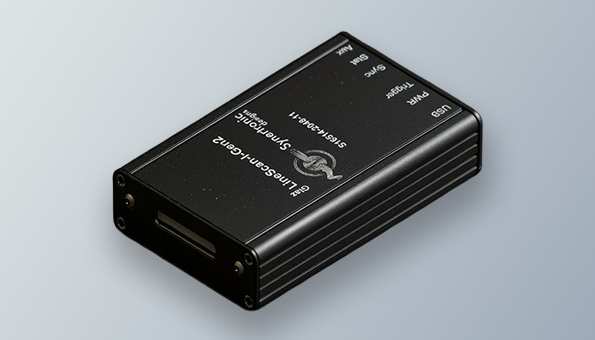
How to select the Right CMOS Sensor for Linear Array Cameras: Balancing Sensitivity, Speed, and Spectral Range

When it comes to UV–NIR imaging and spectroscopy, the choice of CMOS sensor determines the limits of both dynamic range and spectral fidelity. Our latest Application Note from Synertronic Designs provides a structured approach to CMOS sensor selection, comparing sensor types, architectures, and their implications for line-scan and spectroscopic applications.

Key engineering insights:

Sensitivity vs. well depth:

High-sensitivity APS sensors excel in low-photon environments such as fluorescence or reflection absorption spectroscopy, but are limited by smaller well-depths (~100 ke–) and an SNR around 500.

Standard sensors with larger well-depths (up to several Me–) achieve SNRs >2500 under strong illumination—ideal for transient absorption spectroscopy (TAS) and other high-intensity setups.

Low dark current and long integration stability:

CMOS sensors offer excellent dark-current performance and can sustain integration times of several seconds without cooling—simplifying system design.

Spectral range and window options:

Standard range:

200–1000 nm (UV–NIR).Windowless variants extend sensitivity down to 140 nm, enabling VUV detection for specialized spectroscopy.

Ongoing Hamamatsu developments, such as the S12198-01, demonstrate improved UV response.

Readout architecture and line rate:

With a 10 MHz pixel clock, achievable line rates depend on pixel count—up to 18 kHz for 512-pixel sensors, scaling down to ~2 kHz for 4k arrays.

Pixel geometry:

Large pixel heights (0.2–0.5 mm) and pitches from 14–25 µm enable high collection efficiency and robust coupling to spectrographs or fiber arrays.

From TAS systems to broadband reflectance setups, understanding these trade-offs ensures optimal matching between sensor physics and optical design.

Whether you’re building a new LineScan camera or upgrading your OEM spectroscopy platform, sensor choice remains the foundation of performance.

Stay connected

Subscribe to our email updates to be the first to know about new product launches and publications (case studies, application notes, new projects).