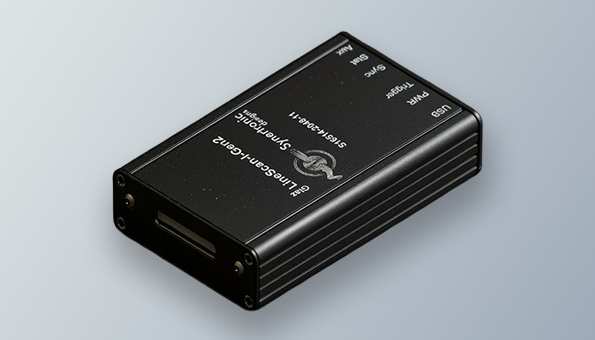
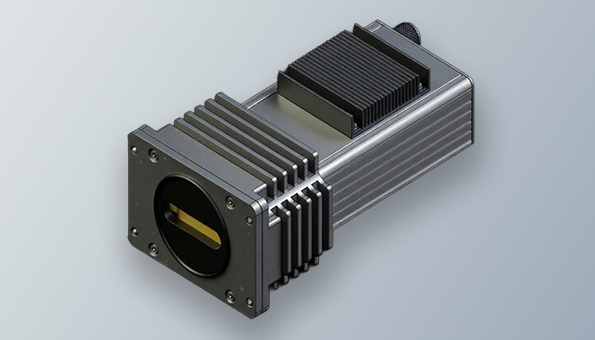
Our CMOS-based linear array cameras (Glaz LineScan-I-Gen2 and Glaz-LineScan-I) are used in cutting-edge optical spectroscopy, ultrafast dynamics, and photophysical investigations worldwide.
This article provides a technical overview of CMOS sensors and guidance on selection.
This article provides a technical overview of InGaAs sensors and guidance on selection.
This article provides an overview of sensor noise considerations and provides background for sensor selection.
This article shows how to calculate quantum efficiency for CMOS sensors.
Several clients requested custom mounts to attach the Glaz LineScan directly onto Andor Spectrographs. These included the Shamrock 163 and Kymera 193.
Most OEM solutions also require a custom software API. This is an example of a custom API for an OEM InGaAs camera.
One of our clients requested a low-speed OEM version of our InGaAs cameras with G11620 sensor.
The G11478-512WB Datasheet provides detailed technical specifications for the supported LineScan InGaAs sensor.
The G11478 Datasheet provides detailed technical specifications for the supported LineScan InGaAs sensor.
The G11608-256DA Datasheet provides detailed technical specifications for the supported LineScan InGaAs sensor.
The G11620 Datasheet provides detailed technical specifications for the supported LineScan InGaAs sensors: G11620-256DA & G11620-512DA.
The Glaz series shares a unified API framework designed for consistent integration across all sensor variants—from InGaAs and CMOS LineScan platforms to dual-channel architectures and the Glaz-PD digitizer. Access the latest Glaz API release notes here.
The Glaz API User Manual provides comprehensive guidance for all devices in the Glaz series.
The Glaz LabView 32-bit (9.23) driver is a universal interface layer for the entire Glaz series.
The Glaz LabView 64-bit (9.23) driver is a universal interface layer for the entire Glaz series.
The Glaz LabVIEW toolkit supports every device in the Glaz series, offering a consistent VI architecture for data acquisition, control, and high-speed readout across InGaAs, CMOS, dual-sensor, and Glaz-PD platforms. Access the latest Glaz LabVIEW release notes here.
The Glaz LabVIEW User Manual for Drivers delivers complete instructions for integrating every device in the Glaz series within LabVIEW environments.
The Glaz LineScan-I User Manual provides detailed guidance specifically for the legacy Glaz LineScan-I device.
The Glaz UI (13.4) is a universal interface layer for the entire Glaz series.
The Glaz UI User Manual covers the complete Glaz series.
The Glaz USB driver is a universal interface layer for all the Synertronic Products.
The LineScan-I-Gen2 User Manual provides comprehensive guidance for all LineScan-I-Gen2 devices—CMOS, Dual CMOS, and InGaAs.
The S11637-2048Q Datasheet provides detailed technical specifications for the supported LineScan CMOS sensor.
The S11639-01 Datasheet provides detailed technical specifications for the supported LineScan CMOS sensor.
The S12198 Datasheet provides detailed technical specifications for the supported LineScan CMOS sensors: S12198-512Q-01 and S12198-1024Q-01.
The S16514-2048-11 Datasheet provides detailed technical specifications for the supported LineScan CMOS sensors.
The Glaz series shares a unified API framework designed for consistent integration across all sensor variants—from InGaAs and CMOS LineScan platforms to dual-channel architectures and the Glaz-PD digitizer. Access the latest Glaz API release notes here.
The Glaz LabVIEW toolkit supports every device in the Glaz series, offering a consistent VI architecture for data acquisition, control, and high-speed readout across InGaAs, CMOS, dual-sensor, and Glaz-PD platforms. Access the latest Glaz LabVIEW release notes here.
.png)